Fast by default
Stay in the terminal and keep your hands on the keyboard.
Open-source terminal REST client
Write, send, inspect, and automate HTTP requests from readable files without leaving your terminal. Keep every collection versioned beside the code it exercises, ready for the TUI, CLI, scripts, and coding agents.
curl -LsSf https://noodlerest.dev/install.sh | sh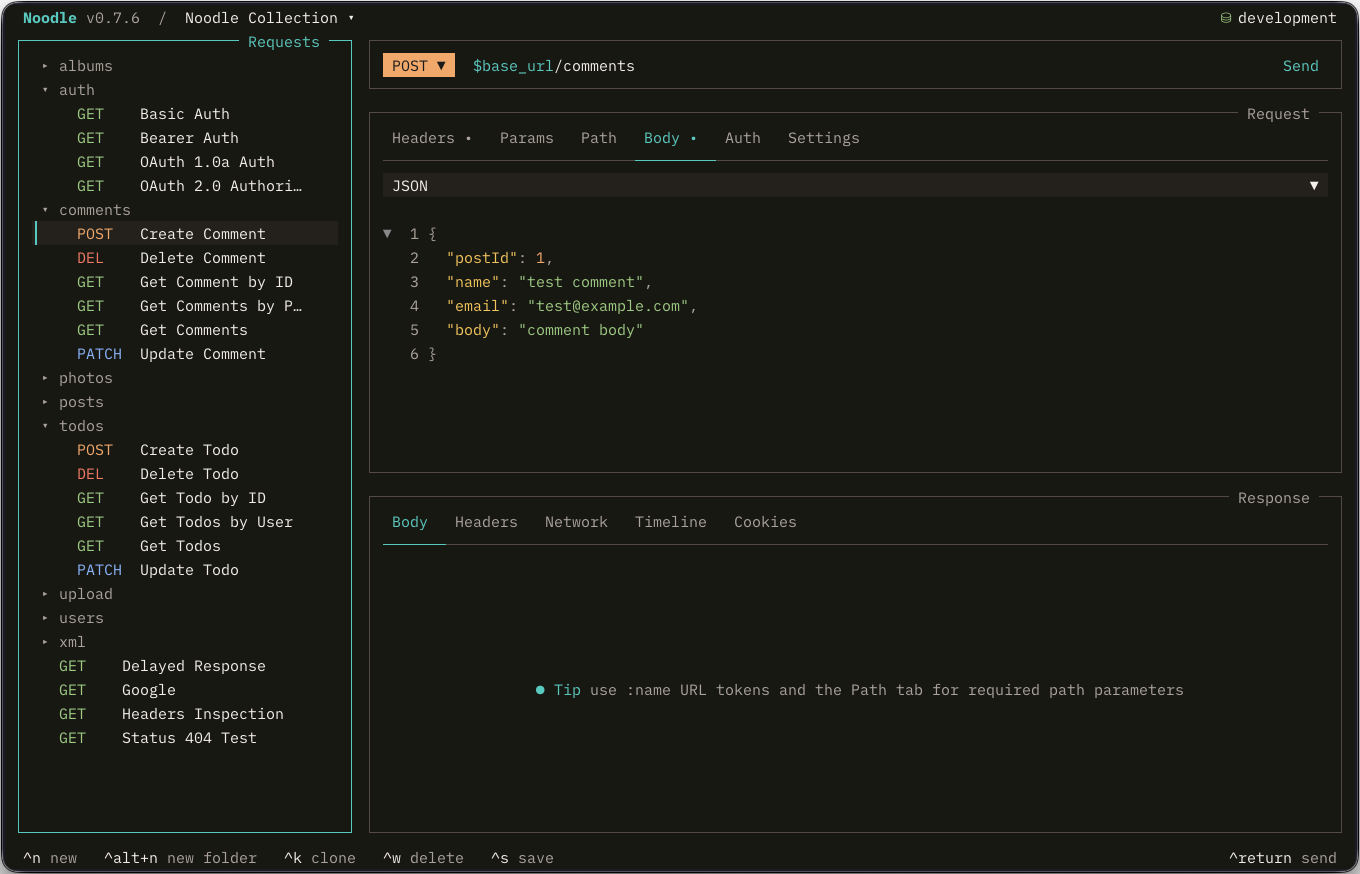
Stay in the terminal and keep your hands on the keyboard.
Keep requests and environments readable beside your code.
Use the same collection from the TUI, CLI, scripts, and agents.
Every request is a readable YAML file. Edit it in Noodle or your editor, review it in Git, and keep it beside the code it exercises.
Request file referencename: Get user
method: GET
url: "$base_url/users/:id"
headers:
Accept: application/json
params:
id: 42{
"id": 42,
"name": "Ada Lovelace",
"role": "developer"
}Compose a request, send it, then move through body, headers, cookies, and timing from the same keyboard-first workspace.
Inspecting responsesSwitch between development, staging, and production variables. Secret declarations stay in the file while values live in the OS credential vault or process environment.
Using environmentsAPI_TOKENOS credential vaultnoodle request run users/get --collection ./apinoodle collection audit ./apinoodle collection run ./api smoke/ health --env staging --jsonnoodle agent installstatus success · exit 0 · JSON available
Explore interactively in the TUI, chain captured response values across ordered runs, enforce response assertions, or give coding agents the supported Noodle skill.
Automation guideFocused enough to stay fast, complete enough to handle real API work.
URL, params, headers, body, and auth
Body, headers, cookies, status, timing, and assertions
Folders, inherited context, and Git-friendly files
Switchable variables and secure values
Proxy, TLS, mTLS, and authentication
Import OpenAPI, Swagger, Postman, and Insomnia. Export OpenAPI and Postman.
Planned directions, clearly separated from what Noodle ships today.
Install Noodle and open your first collection.
curl -LsSf https://noodlerest.dev/install.sh | sh